Concrete calculator
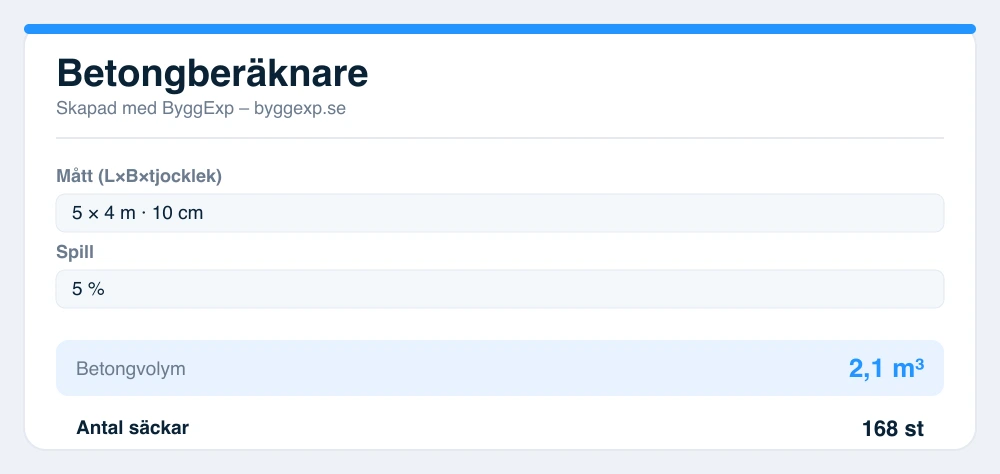
Enter the measurements – concrete volume, bags and a guide price, instantly.
More options
Estimate incl. waste per a typical build-up (crushed stone → EPS 200–300 mm → mesh + edge bars → concrete + edge beam). An L-shaped slab has a larger perimeter and therefore more edge beam, edge insulation and edge bars. The cost is a guide price – a finished slab on grade is often ~1,100–1,800 kr/m² incl. labour. Prices and labour times are editable. Always check against drawings and the structural engineer’s dimensioning.
Want help taking this further?
Briefly describe what you need and we’ll help you with a quote, material and next steps – free of charge. Only the contact field is required.
An estimate, not a finished calculation – check against drawings, regulations and supplier data before pricing or ordering.
How the volume is calculated – per pour
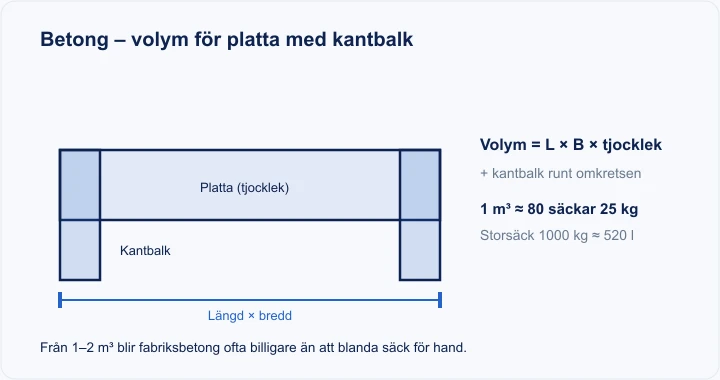
- Slab / floor: length × width × thickness. With an edge beam, add perimeter × edge-beam width × height.
- Footing / beam: length × width × height.
- Piers / post holes (round): π × radius² × depth, times the number of holes.
From volume to bags and water
- 1 m³ = 1000 litres of concrete.
- A 25 kg bag of dry-mix ≈ 12.5 litres → about 80 bags per m³.
- A 1000 kg big bag ≈ 520 litres.
- Mixing water: about 3–4 litres per bag.
Slab on grade: don’t forget the edge beam
The thickened edge holds more concrete than you might think. A 5 × 10 m garage gives about 5 m³ in the slab itself but almost another 1 m³ in the edge beam – always include it, otherwise you will order too little.
Bagged or ready-mix concrete?
For smaller jobs, bagged concrete is convenient. From roughly 1–2 m³, ready-mix concrete (delivered by truck) is usually both cheaper and easier than mixing many bags by hand – and you finish the pour before the concrete starts to set.
Bädda in kalkylatorn gratis på din sajt
Har du en egen sajt, blogg eller kundportal? Bädda in den här kalkylatorn gratis – kopiera koden nedan och klistra in där du vill ha den. En liten länk tillbaka till ByggExp följer med.
Frequently asked questions about concrete
- How do I calculate concrete volume?
- The base formula is measurements in metres multiplied together – a slab is length × width × thickness, so 5 × 4 × 0.10 = 2 m³. Beams, footings and round piers each have their own formula, but the calculator picks the right one for what you are casting and adds waste, so you don’t have to track them.
- How many bags of concrete are in a cubic metre?
- Reckon about 80 bags of 25 kg per cubic metre, or a 1000 kg big bag that covers a bit over half a cubic metre. The exact yield is printed on the packaging and varies by brand – buy one bag too many rather than one too few.
- Do I have to include the edge beam?
- Yes – the thickened edge holds surprisingly much concrete and is easy to overlook. Choose "Edge beam: Yes" and enter its width and height, and the volume around the whole slab perimeter is added automatically.
- How much water do I need to mix in?
- Reckon about 3–4 litres of water per 25 kg bag. The calculator shows a guide value for the whole amount – follow the product instructions for the exact consistency.
- When should I order ready-mix instead of bags?
- For larger pours, from around 1–2 m³, ordering ready-mix is usually worth it – no hauling and mixing bags by hand, and a more even quality across the whole pour. Below that, bagged concrete is fine.
- Does it cost anything?
- No, the calculator is free and requires no account.