U-value – work out the heat transmission
Planning to add insulation or pick the right insulation thickness? Build the wall, roof or floor up layer by layer and see how well the construction holds the heat. You get the thermal resistance and U-value (W/m²K) on screen – no hand calculation needed.
Simplified calculation for homogeneous layers (U = 1 / Rtot). With insulation between timber studs the value is lowered by thermal bridges – use the so-called λ-method or the U-value from the manufacturer’s data.
Want help taking this further?
Briefly describe what you need and we’ll help you with a quote, material and next steps – free of charge. Only the contact field is required.
An estimate, not a finished calculation – check against drawings, regulations and supplier data before pricing or ordering.
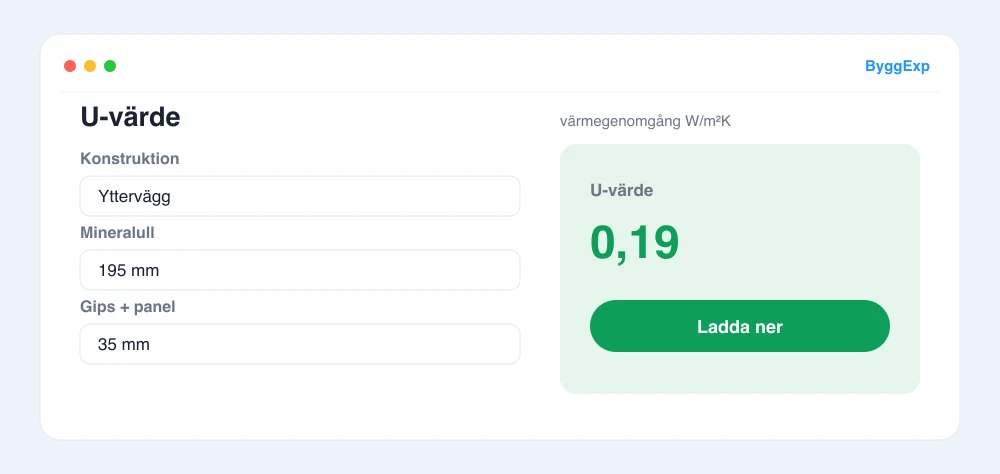
How the U-value works
The U-value describes how much heat passes through a construction per square metre and degree of temperature difference. The lower the value, the better the insulation. It is calculated from the sum of all material layers’ thermal resistance plus the surface resistances on the inside and outside.
Each layer’s resistance is R = thickness (m) ÷ λ. A thicker or more insulating layer (lower λ) gives a higher R and therefore a lower U-value.
Mind the thermal bridges
With insulation between timber studs, the studs conduct more heat than the insulation. This calculator works on homogeneous layers – for a stud wall the real U-value is somewhat higher. Use the manufacturer’s U-value data or the λ-method when it needs to be exact.
Frequently asked questions about the U-value
- How do you calculate the U-value?
- The U-value is 1 divided by the total thermal resistance: U = 1 / (Rsi + ΣR + Rse). Each material layer’s resistance R is the thickness (in metres) divided by the lambda value (λ), and the surface resistances Rsi and Rse are added for the inside and outside.
- What is a good U-value?
- Lower is better. A well-insulated external wall is often around 0.15–0.18 W/m²K and modern windows around 0.9–1.2 W/m²K (Uw for the whole window). Check the current requirements at Boverket for your work.
- What is the difference between Uw and Ug for windows?
- Ug is the glass only, Uw the whole window including frame and sash. Uw is always higher (worse) than Ug – always compare Uw to Uw when evaluating windows.
- Does the calculator cost anything?
- No, it is free and requires no account.