Calculate roof trusses
Work out the number of roof trusses from the roof length and centre spacing (c/c). Add the span and roof pitch to get the ridge height, top-chord length and roof area – with a sketch of the truss. Free, no account.
Truss geometry (optional)
An estimate (count = length ÷ c/c + 1). A common c/c is 1200 mm, but follow the engineer’s dimensioning for your truss and snow load.
Pure geometry for a symmetric gable truss, measured to the chord centre lines. Timber sizes, webs and fixings come from the truss manufacturer’s engineer.
Want help taking this further?
Briefly describe what you need and we’ll help you with a quote, material and next steps – free of charge. Only the contact field is required.
An estimate, not a finished calculation – check against drawings, regulations and supplier data before pricing or ordering.
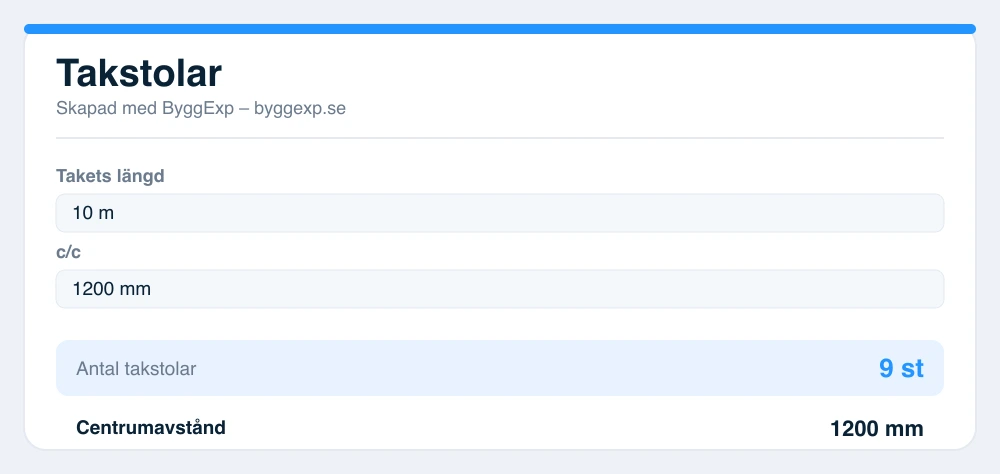
How to calculate the number of trusses
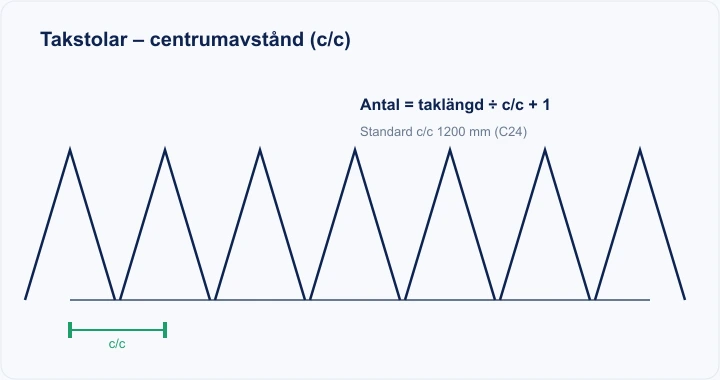
The truss count uses a simple formula: count = roof length / c/c + 1. The extra truss is so that both gables also get a truss.
- Measure the roof length in metres.
- Enter the spacing (c/c) in mm.
- See the number of trusses instantly.
Example truss calculation
A roof 10 metres long at c/c 1200 mm: 10,000 / 1200 = 8.33, rounded up to 9, plus 1 = 10 trusses. At a closer c/c of 600 mm it becomes about 18 trusses for the same roof – so the spacing drives both the count and the material.
Which c/c spacing should the trusses have?
The spacing (c/c) depends on the roof covering, sub-roof and snow load. The standard is 1200 mm for prefabricated trusses – also for concrete and clay tiles, since the trusses are then designed for a heavy roof. Closer c/c (600 or 900 mm) occurs in some cases, but the manufacturer decides. Always use the c/c on the truss drawing.
Count vs. dimensioning of trusses
This calculator does a truss count – not a structural calculation. Dimensioning of trusses (choice of timber sizes, span and fixings from snow and wind load) must be done by an engineer per Eurocode. Use the count here for material and quotes, and always follow the engineer’s drawing for the execution.
Bädda in kalkylatorn gratis på din sajt
Har du en egen sajt, blogg eller kundportal? Bädda in den här kalkylatorn gratis – kopiera koden nedan och klistra in där du vill ha den. En liten länk tillbaka till ByggExp följer med.
Frequently asked questions
- How do you calculate the number of trusses?
- Take the roof length divided by the spacing (c/c) and add one truss. A 10 m roof at c/c 1200 mm gives 10 trusses. Enter your measurements and the calculator does it for you.
- How many trusses do I need?
- It depends on the roof length and the c/c you choose. Always round up and add one truss for the gable – that is why the formula ends in +1. The calculator handles the rounding.
- What c/c spacing do trusses have?
- Common is 1200 mm, but it depends on the covering, snow load and dimensioning. Follow the engineer’s specification.
- What is the difference between counting and dimensioning trusses?
- This calculator counts trusses from c/c. Dimensioning – determining timber sizes from span and snow load – is done by an engineer per the applicable load.
- Are gable ends and noggins included?
- No, the calculator counts the ordinary trusses. Gable construction and trimming come in addition.
- Does it cost anything?
- No, the roof-truss calculator is free and requires no account.